0
Your Cart
0
Your Cart

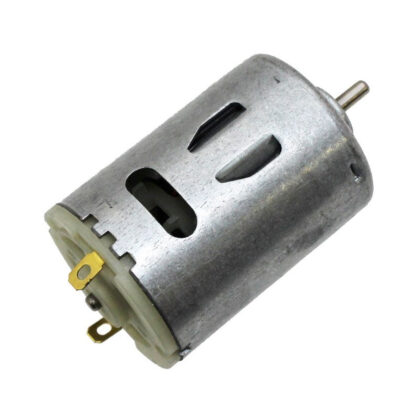
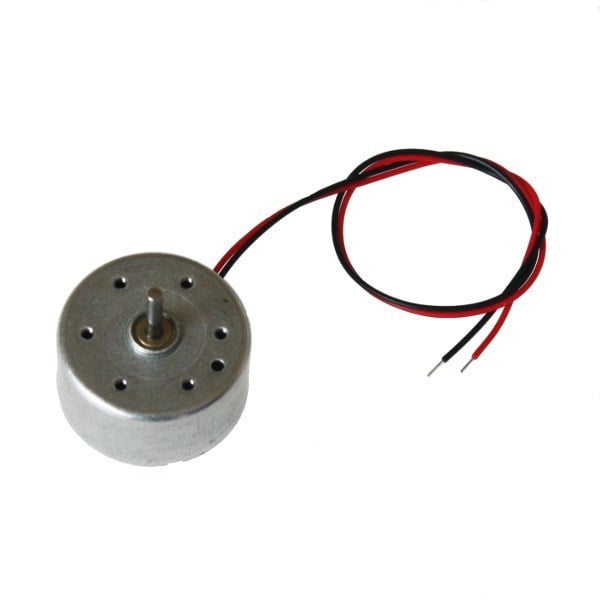
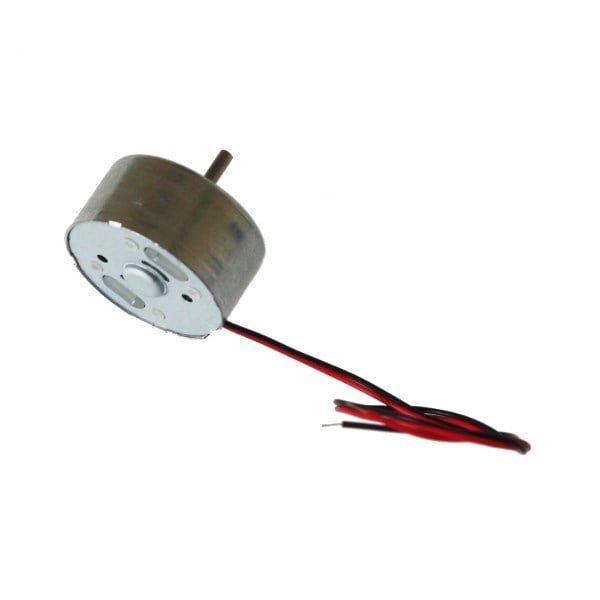
This is a low inertia motor that can be powered from a suitably rated solar cell. This is because these motors have a starting current of just 30mA at 0.5V.

The motor works from a voltage in the 0.5V to 3V range.

The motor has red and black 150mm flying connecting leads.

Features:

  • Low inertia ideal for using with solar power.
  • Low starting current.

Contents:

  • 1 x Low Inertia Solar Motor – 1820 RPM.

Dimensions:

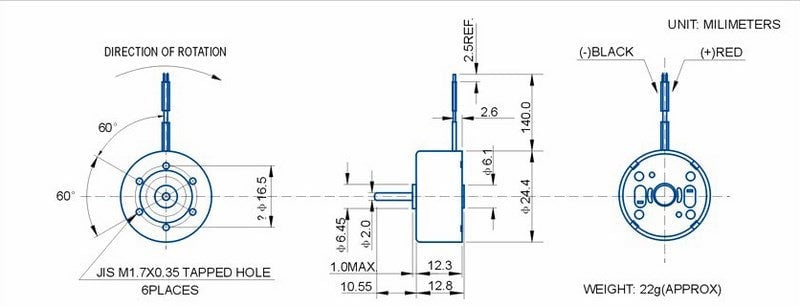
  • Height: 12.8mm.
  • Diameter: 24.4mm.
  • Axle Length: 10.55mm.
  • Axle Diameter: 2mm.

Technical Information

AttributeValue
Height 12.8mm.
Diameter 24.4mm.
Axle Length 10.55mm.
Axle Diameter 2mm.
Weight 22g.
Operating Voltage 0.5V - 3V.
Rated Voltage 2V.
Starting Voltage 0.5V.
Starting Speed 1000RPM.
Starting Current 30mA.
Voltage at Maximum Efficiency 2.0V.
Speed a

Related resources

This product doesn't have any resources.

1 review for Low Inertia Solar Motor – 1820 RPM

  1. Jonk

    We were needing a small motor for a ferris wheel on our model railway layout and this one fits perfectly!

Add a review

Your email address will not be published. Required fields are marked *

Questions and answers

    Does this motor have a 2mm shaft?
  1. 0 votes
    Q Does this motor have a 2mm shaft?
    Asked by Anonymous on July 8, 2020 12:00 am
    Answered by the admin
    Thank you for your email, this motor does indeed come with a 2mm Diameter shaft

  2. Trying to make a model wind turbine, that will power an led in class, which motors would you suggest, as I can't get the little motors we have to work
  3. 0 votes
    Q Trying to make a model wind turbine, that will power an led in class, which motors would you sugg...... Read more
    Asked by Anonymous on May 23, 2019 12:00 am
    Answered by the admin Hi Duncan, I would recommend the two low inertia solar motors, preferably the 1820 RPM one as that should be the one that will work the easiest. Best Regards Cullen
  4. Could I attach a wheel directly to the motor
  5. 0 votes
    Q Could I attach a wheel directly to the motor
    Asked by Anonymous on November 23, 2018 12:00 am
    Answered by the admin HI Joe, In theory yes provided you had a wheel that fitted the spindle of the motor. best Regards Cullen Lewis
  6. If I used this as a generator, would I be able to measure current or voltage produced with a multimeter?
  7. 0 votes
    Q If I used this as a generator, would I be able to measure current or voltage produced with a mult...... Read more
    Asked by Anonymous on June 25, 2018 12:00 am
    Answered by the admin Hi Graeme, Yes this should be suitable, attached the multi meter to the wires, set it to measure either current or voltage and spin the motor (or use a fan blade and blow on the fan). Similar to this, https://www.kitronik.co.uk/blog/experiment-7-wind-power
  8. Hi, if I would like to power this motor directly from the microbit, is that possible or will there be to much current from one pin and damage the microbit.Could I connect black to ground and red to a GPIO pin and for example set digital pin 1 to 1 to make it start?
  9. 0 votes
    Q Hi, if I would like to power this motor directly from the microbit, is that possible or will ther...... Read more
    Asked by Anonymous on June 8, 2018 12:00 am
    Answered by the admin Thank you for your question, it would not be possible I am afraid, it is not the Voltage that would be a problem but the current draw as the micro:bit is not able to output enough current from a pin to supply even this low power motor. You would need a separate power source. Best Regards Cullen
  10. I would like to use this motor in combination with a raspberry pi. More specifically I want to adjust the speed of the motor using pulse width modulation (PWM). To do this I need to know the value for the herz parameter for the PWM. My question is thus: What is the range of usable herz values for this motor? Thanks in advance for any help!
  11. 0 votes
    Q I would like to use this motor in combination with a raspberry pi. More specifically I want to ad...... Read more
    Asked by Anonymous on January 10, 2018 12:00 am
    Answered by the admin Hi MuadDev, It is possible to calculate the hertz from the RPM by dividing the RPM by 60. The starting speed for the motor is 1000RPM so 16.66 hertz and the Speed at Maximum Efficiency is 2000RPM so 33.33 hertz. I hope this helps.
  12. What is the torque of this motor? Thanks :)
  13. 0 votes
    Q What is the torque of this motor? Thanks :)
    Asked by Anonymous on November 27, 2017 12:00 am
    Answered by the admin Hi Samuel, The motor has a torque of 3.03 g.cm, when powered at 2V, and draws 62mA which is the max efficiency of the motor. The torque at the point the motor stalls is 12g.cm.
  14. What would be the speeds of the kitronik-05-3v-small-1820-rpm-solar-motor at 1 V, 1.5 V, 2 V and 2.5 V?
  15. 0 votes
    Q What would be the speeds of the kitronik-05-3v-small-1820-rpm-solar-motor at 1 V, 1.5 V, 2 V and ...... Read more
    Asked by Anonymous on July 26, 2016 12:00 am
    Answered by the admin Hello Sanjay, The motor has a starting speed of 1000 RPM at a 0.5V supply, and spins up to 1820RPM at 3V. However we don’t have any data to say what the motor will spin at when supplied with the voltages you have stated. The speed should however progressively increase as the voltage is increased.
  16. Looking to make Brushbots with Yr5, need 3v buzzers or vibration motors to power a tooth brush head. Would this cause enough of a vibration to move a tooth brush head and would it sit on it?ThanksClare
  17. 0 votes
    Q Looking to make Brushbots with Yr5, need 3v buzzers or vibration motors to power a tooth brush he...... Read more
    Asked by Anonymous on June 9, 2015 12:00 am
    Answered by the admin This motor spins at 1820 revolutions per minute, so it might not be the best motor for what you are wanting to use. We do a small 3V vibrating motor, these motors are often used for silent alert functions in mobile phones, the product code is 2541
To submit a question, please login or create an account