0
Your Cart
0
Your Cart

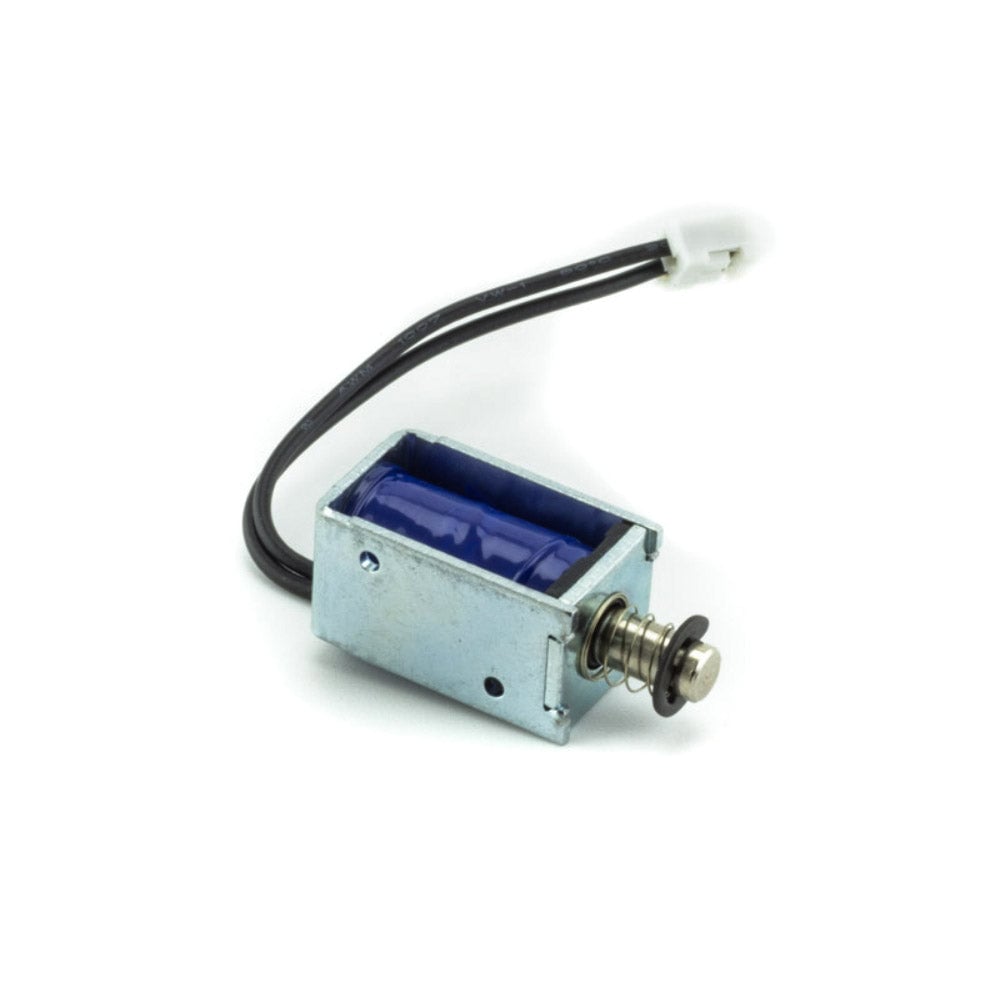
Solenoids are a great way to induce linear motion for pushing, pulling or controlling switches and levers.This smaller solenoid is designed to work directly with 5V which makes it a great match for embedded projects. It has a throw of about 4.5mm and 2 M2 mounting holes on the body.

The wire lead is about 2″ long and is terminated with a 2-pin JST PH connector.

Click here to download datasheet pdf_icon.gif
When reading this datasheet the part is a push type, with a push shaft type B.
Related resources

This product doesn't have any resources.

Reviews

There are no reviews yet.

Be the first to review “Solenoid (5V)”

Your email address will not be published. Required fields are marked *

Questions and answers

    How can this component be integrated to a circuit- given the PH connector?
  1. 0 votes
    Q How can this component be integrated to a circuit- given the PH connector?
    Asked by Anonymous on February 8, 2019 12:00 am
    Answered by the admin Hi Kate, Thank you for your question, you could cut the connector off and once you used a multimeter to work out the positive and negative wire you could wire them into the circuit that way. Best Regards Cullen
  2. How much force dose this have? And how much current do you need for max for Example?
  3. 0 votes
    Q How much force dose this have? And how much current do you need for max for Example?
    Asked by Anonymous on November 28, 2018 12:00 am
    Answered by the admin Hi Paul, this would depend on your supply voltage and also the duty cycle at which you would set this to. If it was based on a 5V supply voltage you could obtain approximately a 300gf as a maximum, however this would only be moving around 0.5mm and based on needing 12W would be around 2A. You could only sustain this for a 10% duty cycle, as such it could only do this for 1 second in a 10 second period. If you were wanting a constant cycle you could achieve around 80gf as a maximum moving a similar distance on the stroke. The bottom graph in the datasheet shows how the force is effected by the distance the solenoid moves.
  4. Can this be driven directly by the BBC micro:bit? If not, do you have a relay for the micro:bit that can drive it?
  5. 0 votes
    Q Can this be driven directly by the BBC micro:bit? If not, do you have a relay for the micro:bit t...... Read more
    Asked by Anonymous on October 22, 2018 12:00 am
    Answered by the admin Hi there, Thank you for your question. In theory yes if your solenoid was low enough current it would work but it would need to be 5-10mA of current draw as the micro:bit cannot supply a lot directly. You would need to instead use one of our BBC micro:bit Motor Driver Board, our BBC micro:bit Robotics board or the Monk Makes Relay Board we sell. These are linked below https://www.kitronik.co.uk/46123-low-voltage-relay-for-microbit-solid-state.html https://www.kitronik.co.uk/5620-motor-driver-board-for-the-bbc-microbit-v2.html https://www.kitronik.co.uk/5641-all-in-one-robotics-board-for-bbc-microbit.html Best Regards Cullen
  6. Could you suggest a suitable MOSFET to drive this from a PICAXE18M2?
  7. 0 votes
    Q Could you suggest a suitable MOSFET to drive this from a PICAXE18M2?
    Asked by Anonymous on January 2, 2018 12:00 am
    Answered by the admin Hello Andrew, Unfortunately we don't have any MOSFET, also depending on the application that the solenoid is being used in would depend on what item you would require.
  8. Do you have PUSH type solenoid?There is a pull type solenoid on the picture above.
  9. 0 votes
    Q Do you have PUSH type solenoid?There is a pull type solenoid on the picture above.
    Asked by Anonymous on May 28, 2014 12:00 am
    Answered by the admin This solenoid is the push type. The image is however just a stock photograph provided by the manufacturer for the entire range of solenoids.
To submit a question, please login or create an account