
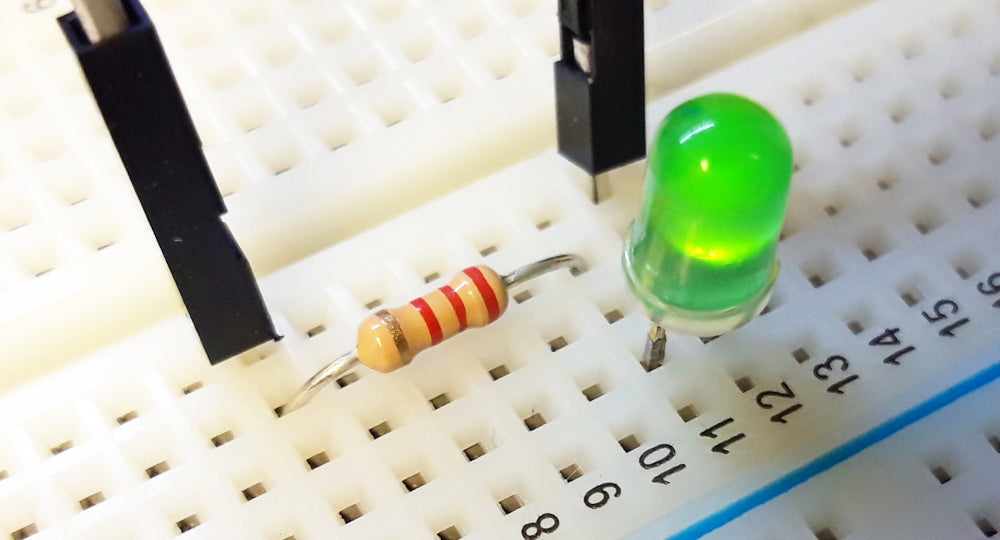
Choosing a resistor to work with an LED is fairly simple, but does require some knowledge of the LED and a small amount of maths. Some LEDs such as colour changing LEDs, flashing LEDs and 5V LEDs are designed to run off a 5V supply and therefore don’t need a resistor. All other standard and bright LEDs will need a current limit resistor. LED stands for Light Emitting Diode and as the name suggests, it is a diode that emits light. When a diode is put in a circuit 0.7V is dropped across it. Similarly LEDs have a voltage dropped across them know as the forward voltage, though this is different for every LED. For a standard LED the forward voltage will typically be 2V, where as an ultra bright LED will be about 3.5V. A proportion of the battery voltage is dropped across the LED (the forward voltage) and the rest of the voltage is dropped across the resistor. This is shown in the diagram top right. We can therefore write this as: 

The resistance can be calculated using Ohms Law:

LEDs typically require 10 to 20mA, the datasheet for the LED will detail this along with the forward voltage drop. For example an ultra bright blue LED with a 9V battery has a forward voltage of 3.2V and typical current of 20mA. 
So the resistor needs to be 290 ohms or as close as is available.
Let your computer do the work

We have added a great tool to the Kitronik website that takes the strain out of calculating the current limit resistor. Simply select which LED you are using from a drop down list. Enter the battery voltage and it will tell you what resistor to use. It even tells you what the colour bands will be on the resistor. Click here to visit the calculator page
Learn more about the author read more »