
It’s been 10 months since the BBC first got in touch with us to ask if we’d like to become a BBC micro:bit partner. Given the sheer ambition of this project, a landmark education initiative that will give up to 1 million BBC micro:bits to every UK child in year 7 (or equivalent) this autumn, how could we not want to be one of 28 partners – a groundbreaking collaboration and the world’s first, convened by the BBC.

And now, we’re delighted to announce following todays official launch, we can launch our own ambitious plans.
At Kitronik we will be focusing on using the BBC micro:bit within D&T, this gives us access to soldering irons, sewing machines, 3D printers, laser cutters and so on that won’t necessarily be available in ICT or computing. The BBC micro:bit has an expansion connector that allows students to do some really exciting things with their BBC micro:bit and our involvement in the project is all to do with using the expansion connector within D&T.

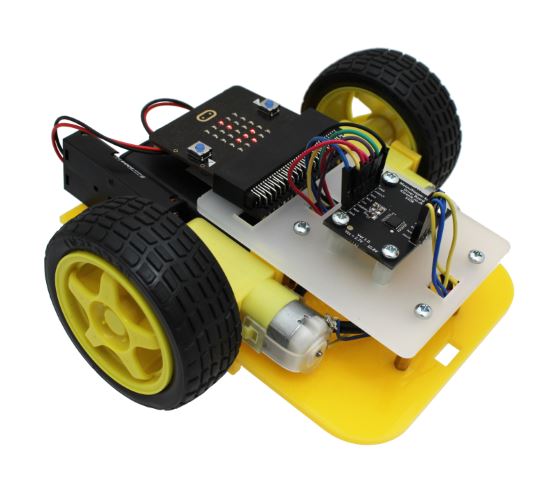
Prototype of collision detection buggy using the BBC micro:bit expansion port.
We’ll be using the knowledge we’ve gained from having developed the kits & teaching materials to support the sales of over a million educational electronic project kits to deliver a range of resources for the BBC micro:bit project. These resources will cover using the BBC micro:bit expansion connector with additional components and also using conductive thread so that the BBC micro:bit can be included in an e-textiles project. These resources will give step by step instructions describing everything a student will need to do to make the project as well as the details of how to program the BBC micro:bit.

Prototype of the BBC microbit E-Texitles emoji bag.
So without further ado, we’d like to introduce, the BBC micro:bit Kitronik University Course.